
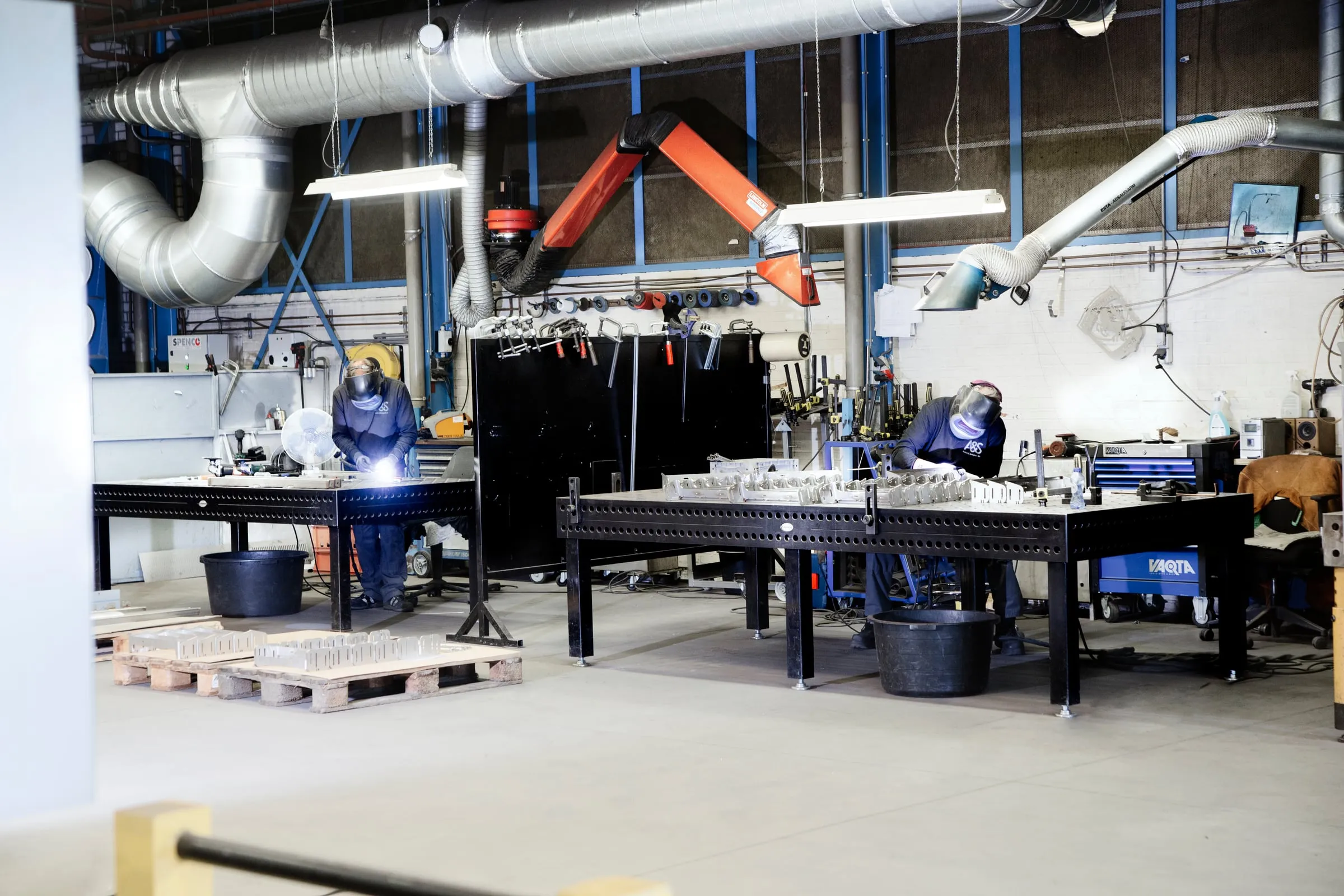
Constructive in constructions
More than 100 years as a specialist in high-quality metal constructions. From individual parts to fully welded assemblies — traditional craftsmanship with modern technology.
Specialist in structural work
Assink & Schipholt carries out heavy and complex welded assemblies — from individual parts to fully welded assemblies. We work for machine building, equipment manufacturing and infrastructure engineering, and handle parts up to 10 tonnes.
The hall has five 5-tonne overhead cranes. By lifting in tandem — two cranes on a single load — we move assemblies of up to 10 tonnes, to a height of 8 metres.
We take care of not only welding and structural work but also surface treatments such as shot blasting, powder coating, anodising and stainless steel passivation — much of it in house. That gives you a single point of contact from engineering to finishing.
A welded construction is more than the sum of its parts. The biggest risks lie in distortion caused by heat input and in dimensional deviations that accumulate through an assembly. That is why we determine the welding sequence during production engineering and not on the shop floor: welding symmetrically where possible, in stages where necessary, and with fixturing on the dimensions that really matter.
We cut sheet on the fibre laser and tube and profile on the Trumpf TruLaser Tube 3000. The latter saves a great deal of manual work in a construction: cut-outs, mitres and mating shapes come straight off the machine, so parts fit together instead of having to be made to fit. The result is a shorter welding time and a more accurate whole.
For welding we work under ISO 3834-2, the standard that sets quality requirements for fusion welding. Load-bearing structures fall under EN 1090-1, which allows us to produce steel and aluminium structures in conformity with CE marking. In practice that means qualified welders, documented welding procedure specifications and traceable material.
Material choice is a trade-off between load, environment and cost. Steel is strong and economical, but needs a coating. Stainless steel 304 and 316 are corrosion-resistant and suited to wet or hygienic environments — you can read more on our page about stainless steel constructions. Aluminium is light, but calls for a different welding approach and for attention to the strength around the weld.
What we need in order to assess a construction: a drawing or 3D model of the assembly, the material and required grade, the dimensional requirements, and the desired finishing. If you do not yet know which surface treatment is appropriate, we will think along — that choice partly determines how the construction has to be welded and lifted.
Materials: Stainless steel 304 / 316 · Aluminium · Brass · Steel
From drawing
to delivery
- 01
Engineering & production engineering
Assessment of the drawing, welding sequence and manufacturability.
- 02
Cutting & preparation
Laser cutting of sheet and tube, bending and fitting.
- 03
Welding & assembly
Manual and laser welding through to the complete assembly.
- 04
Surface treatment
Shot blasting, powder coating, anodising or passivation.
- 05
Inspection & delivery
Dimensional inspection and visual inspection, followed by just-in-time delivery.
Specifications
| Max. weight per piece | up to 10 tonnes |
|---|---|
| Max. height of construction | 8 m |
| Lifting equipment | 5 overhead cranes of 5 tonnes; tandem lifting up to 10 tonnes |
Applications
Machine building (frames, guards) · Equipment manufacturing · Infrastructure engineering · Food industry · Electrical engineering · Mechatronics
Frequently asked questions
How heavy and how tall may a construction be?
We handle parts up to 10 tonnes unit weight and constructions up to 8 metres in height. Five overhead cranes of 5 tonnes are installed in the hall; by lifting in tandem — two cranes on one load — we move assemblies of up to 10 tonnes.
Do you work in accordance with EN 1090?
Yes. We are certified to EN 1090-1, the standard for the execution of steel and aluminium structures with CE marking. For the welding itself we work under ISO 3834-2, and our quality system is certified to ISO 9001.
Do you also take care of the surface treatment?
Yes. Blasting, powder coating, anodising and the passivation of stainless steel are part of the process, much of it in house. That gives you a single point of contact from production engineering through to the finished construction, without having to move the work between suppliers yourself.
In which materials do you weld constructions?
Steel, stainless steel 304 and 316, aluminium and brass. Which material suits best depends on the load, the environment and the required finish; stainless steel is the obvious choice for wet or hygienic environments, aluminium for weight-sensitive structures.
Can you work from a sketch as well?
Yes. We then first assess manufacturability and record the starting points — material, profile selection, welding sequence and dimensions — before production begins. That avoids changes after the fact, which are expensive in a welded construction.
Discuss your drawing,
part or assembly.
Response within one working day · 074-2912235 · info@assinkschipholt.nl