
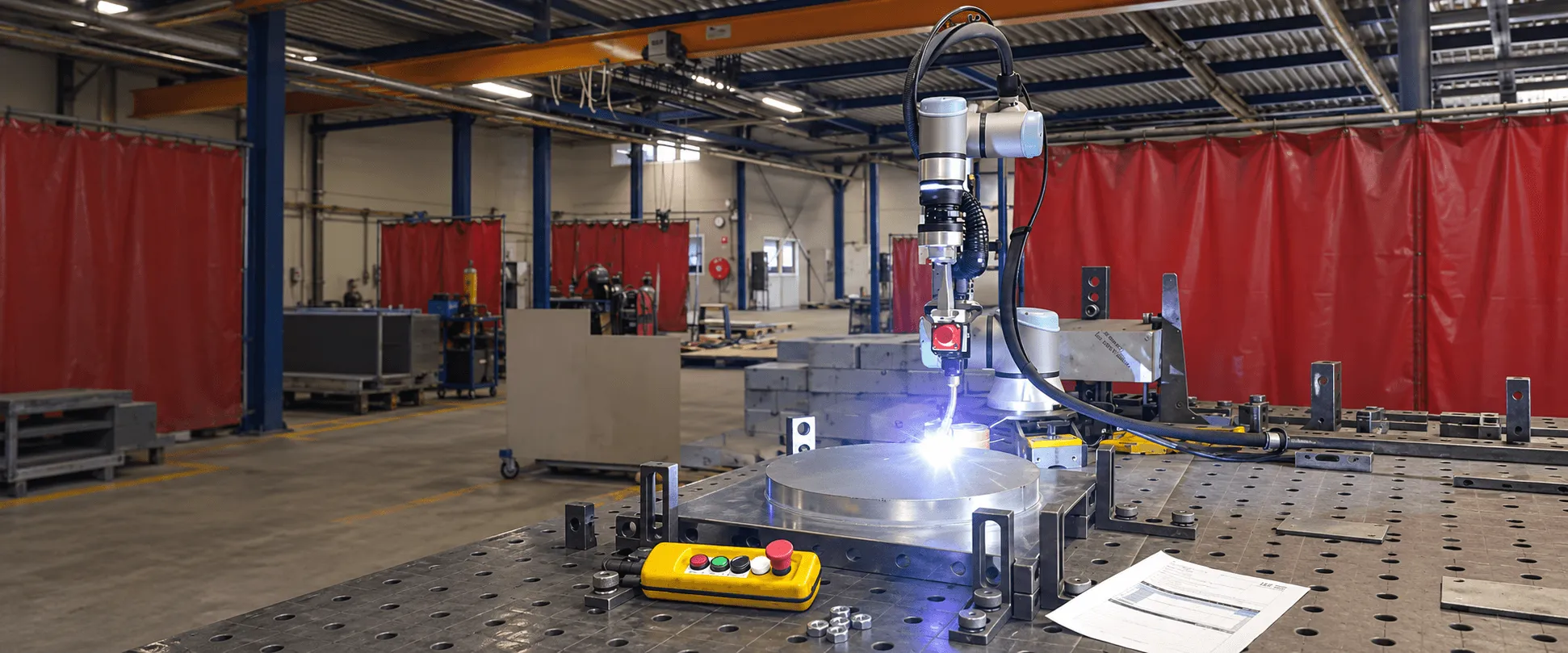
(Cobot) robot welding — automated welding in series
For series welding work, consistency is not a luxury but a requirement. For larger series we bring in automated welding through a regular partner, while the sheet metal work, assembly and finishing take place with us in Hengelo. You keep a single point of contact for the whole series.
About this operation
- Steel
- Stainless steel
- Aluminium
- Medium to large series
- Products with recurring weld seams
- Constructions with strict dimensional stability
Whether automated welding pays off depends less on the number of parts than on the repetition. The time goes in up front: building the fixture, programming the path and dialling in the parameters. For a batch that comes past once, that preparation weighs heavily; for a product that returns every quarter, it earns itself back each time. Give us your annual volume and call-off rhythm and we will work that trade-off through.
We are explicit about the division of roles. Engineering, production engineering, sheet metal work, fixturing, assembly and finishing all happen in Hengelo. The automated welding itself we do not carry out in house: that is done within our group at Baas Metaal. We have no welding robot and no cobot in Hengelo. For you it remains a single order, a single point of contact and one party responsible for the dimensions of the whole.
Read more
Not every product lends itself to it. A welding robot follows a fixed path, so the seam has to be accessible, the parts have to sit identically in the fixture every time, and the preparation has to be tight. Large or varying gaps are the main reason automated welding fails to deliver the expected result.
For small quantities, prototypes and visible work, manual TIG or MIG welding or laser welding is usually the better route. Laser welding introduces little heat and needs little finishing, which counts for more than speed on a tight visible seam.
From drawing to delivery
Engineering
Determining fixturing, welding sequence and accessibility.
Programming
Setting parameters and the welding path.
Automated welding
Carried out by our partner, with monitoring.
Inspection
Seam inspection and dimensional stability.
Specifications
Indicative values — to be confirmed per project- What it delivers
- even bead shape and consistent penetration; less variation, lower rejects, less rework
- Monitored while welding
- current, voltage, travel speed and heat input
- Materials
- steel, stainless steel and aluminium
- Pays off when
- a product returns — not for a batch that comes past once
- In Hengelo
- engineering, production engineering, sheet metal work, fixturing, assembly and finishing
- The welding itself
- within our group at Baas Metaal; there is no welding robot and no cobot in Hengelo
- Requirement
- seam accessible, parts identical in the fixture every time, tight preparation
- Main stumbling block
- large or varying gaps
- Our preparation
- parts cut on the laser, so the gap stays small and consistent
- Better done by hand
- for small quantities, prototypes and visible work
What to send us
Request a quote- PDF drawing and 3D STEP file of the assembly
- Material and sheet thickness
- The weld seams with their requirements
- The quantity per batch and the call-off rhythm
- With that we determine whether automated welding gains you anything, or whether manual welding works out cheaper
Frequently asked questions
From what batch size does automated welding become worthwhile?
There is no fixed number. What matters is repetition: the time goes into building the fixture and programming the path, and that preparation only pays off if the product comes back regularly. Tell us your annual volume and call-off rhythm and we will weigh it against manual welding.
Do you have a welding robot in house?
No. There is no welding robot and no cobot in Hengelo. The automated welding is done within our group at Baas Metaal. We handle the engineering, the sheet metal work, the fixturing, the assembly and the finishing, and keep control of the whole batch.
In which materials can series welding be done?
Steel, stainless steel and aluminium. Parameters and heat input differ per material; with stainless steel, removing heat tint and passivating always follows welding, because otherwise corrosion resistance around the seam deteriorates.
What determines whether my product suits robot welding?
Accessibility of the seam, a repeatable fixture and tight preparation. A robot follows a fixed path, so the parts have to sit identically every time and the gap has to be small and consistent. That is why we cut the parts on the laser.
Who is responsible for quality if the welding is done by a partner?
We are. You have a single order and a single point of contact. We handle incoming inspection, dimensional inspection and assembly, and are accountable for the dimensions of the whole. Our quality system is certified to ISO 9001 and for welding we work under ISO 3834-2.
Discuss your drawing,
part or assembly.
Response within one working day · 074-2912235 · info@assinkschipholt.nl