
Bending & forming
Precise bend angles and consistent dimensioning on our servo-electric press brake.
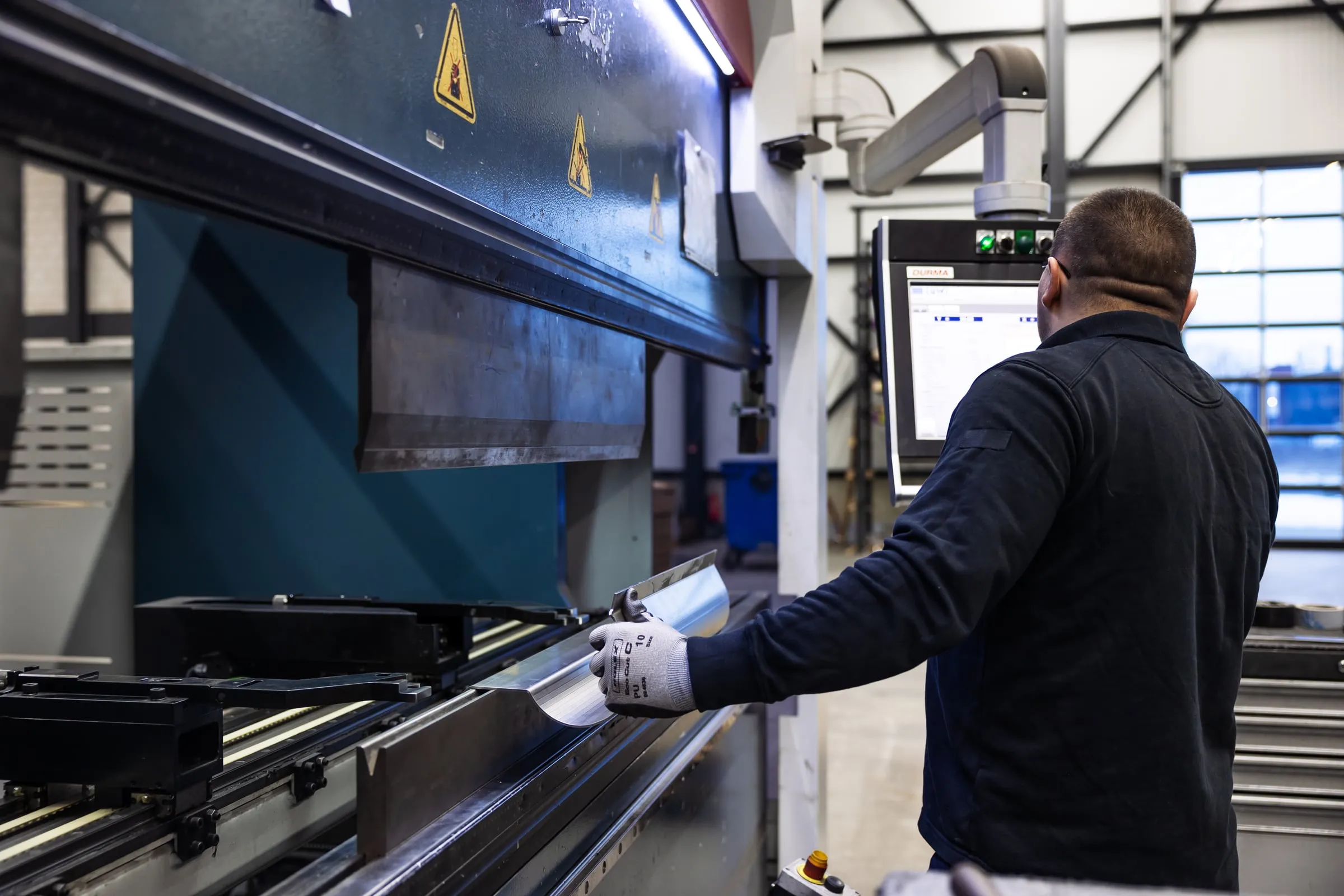
- 150 t
- press force
- 3100 mm
- max. bend length
- ISO 2768
- tolerances
About this operation
- Stainless steel
- Aluminium
- Brass
- Steel
- Enclosures
- Panels
- Casings
- Structural parts
The bend radius is not a detail but a design choice. Too tight a radius cracks the material on the outside; too generous a radius makes the angle harder to control. We determine the radius per request based on material, thickness and tooling, and let you know if your drawing calls for a radius that is not achievable.
Springback is the second factor. Every material springs back a little after bending, so the measured angle ends up larger than the set one. On a servo-electric press brake this can be compensated well because the drive positions accurately and repeatably; we set up for it and check the first bend before the batch runs on.
Read more
The sequence matters too. One bend can get in the way of another, and a flange that sits too close to a hole or cut-out will distort the edge. That is why we assess the bending sequence and the distance from holes to the bend line on the drawing, together with the question of whether the tooling can even reach. That prevents a part turning out to be unmakeable only once it is on the press.
With visible work there is an extra layer. The surface is the most vulnerable part of a bent product: tooling leaves marks, and stainless steel and brass scratch easily. We keep the protective film on up to and including the last operation and use adapted tooling where required. There is more on the material side on our pages about stainless steel sheet metal and brass.
From drawing to delivery
Determining the flat pattern
We calculate the bend allowance ourselves: during bending the material stretches on the outside and compresses on the inside, so the flat length is not the sum of the legs.
Setting up
Setting the tooling and back gauge, with the bend radius and the expected springback for this material.
Press braking
Bending with consistent angular accuracy, in the sequence fixed during production engineering.
Inspection
Angle and dimensional inspection, starting with the first bend before the batch runs on.
Specifications
Indicative values — to be confirmed per project- Machine
- Safan Darley E-Brake 150-3100 T3
- Drive
- servo-electric
- Press force
- 150 tonnes
- Bend length
- up to 3100 mm per bend
- Tolerances
- to ISO 2768
- Bend radius, steel
- inside radius at least equal to the material thickness (rule of thumb)
- Bend radius, aluminium
- wider than for steel — aluminium stretches less
- Bend radius, stainless steel
- rolling direction plays a part
- Springback
- stainless steel springs back more than steel; increases with thickness and hardness
- Flat pattern
- we calculate the bend allowance ourselves
What to send us
Request a quote- A PDF drawing and a 3D STEP file of the finished product — an unfolded drawing is not needed
- Material and sheet thickness
- The required bend radius, if it is fixed
- Whether it concerns visible surfaces
- Quantity
- If you do supply a flat pattern: which bend allowance it was made with
Frequently asked questions
Which bend radius can you achieve?
That depends on material, sheet thickness and tooling. As a rule of thumb, an inside radius at least equal to the material thickness is used for steel; for aluminium it is higher, and with stainless steel the rolling direction counts. If your radius is fixed, tell us and we will assess whether it is achievable before the drawing is finalised.
Do I have to calculate the flat pattern myself?
No. We calculate the bend allowance ourselves, so a PDF drawing and a 3D STEP file of the finished product is enough. If you do supply a flat pattern, tell us which allowance it was made with, otherwise the final dimension will be off.
How long may a single bend be?
Up to 3100 mm in one bend, the working length of our Safan Darley E-Brake 150-3100 T3 with 150 tonnes of press force. Longer parts we build up from several pieces or solve differently in consultation.
Why does stainless steel spring back more than steel?
Stainless steel has a higher yield strength and therefore springs back further after bending, so the measured angle ends up larger than the set one. The thicker and harder the material, the bigger the difference. We compensate for this during set-up and check the first bend before the batch runs on.
Can you bend without scratching visible surfaces?
Yes. We keep the protective film on up to and including the last operation and use adapted tooling where required. Tell us with your request which side is the visible side, and we will take that into account in the bending sequence.
Discuss your drawing,
part or assembly.
Response within one working day · 074-2912235 · info@assinkschipholt.nl