
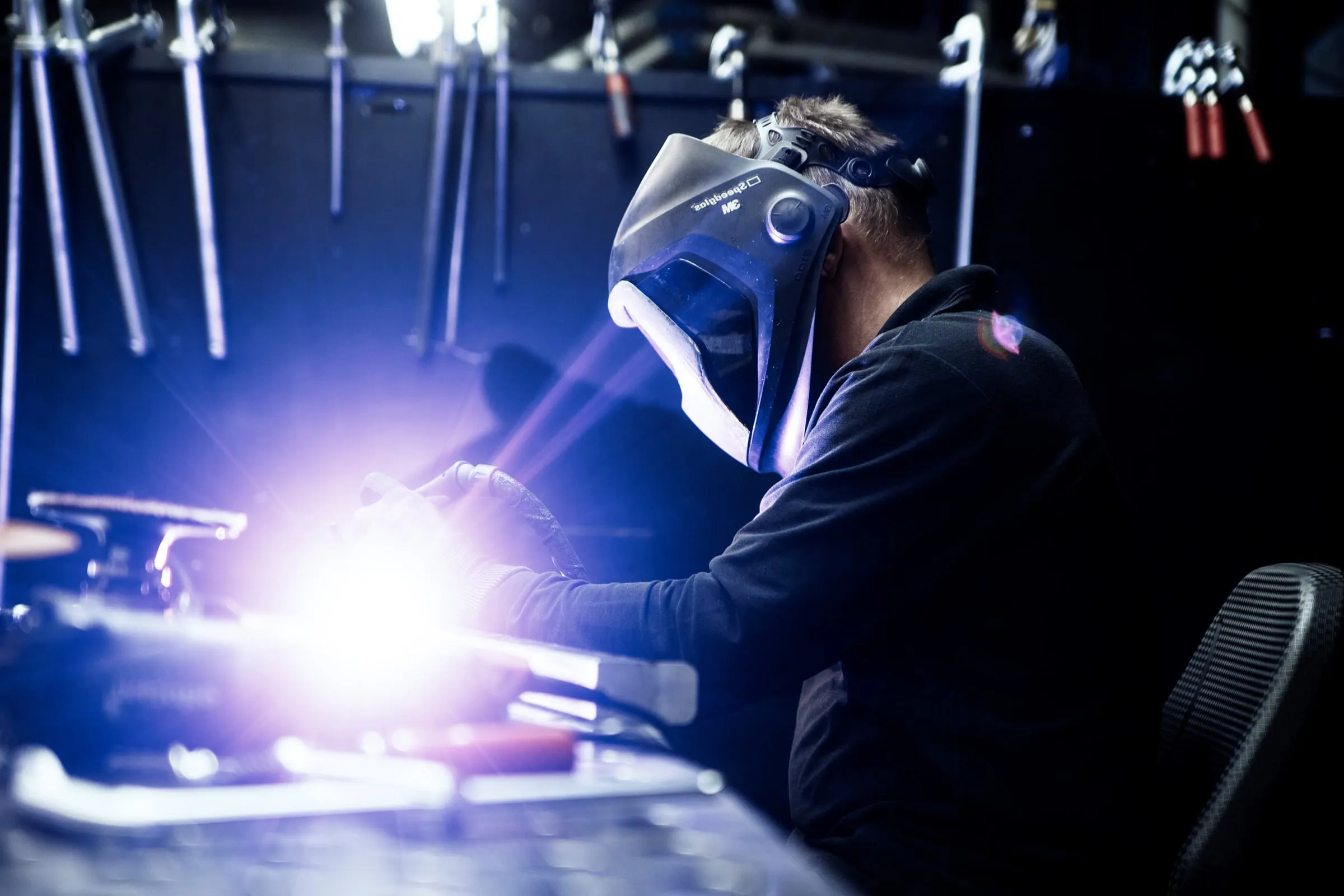
Stainless steel constructions
Corrosion-resistant constructions in stainless steel — from frames to fully welded assemblies, with a hygienic and presentable finish.
About this operation
Stainless steel constructions combine strength with corrosion resistance. We weld and assemble in stainless steel 304 and 316, with finishing (pickling, passivation) matched to the application — for example in the food industry.
Our stainless steel structural work combines tube laser cutting for ready-to-fit profiles with TIG and laser welding, followed by pickling and passivation so the material's corrosion resistance is preserved after processing.
Would you like a stainless steel frame made? Send us your drawing or sketch — we assess manufacturability and think along on profile choice and welding sequence before production starts.
The choice between stainless steel 304 and 316 often determines the service life of the structure. Stainless steel 316 contains molybdenum and is therefore more resistant to pitting corrosion in environments with chlorides — seawater, cleaning agents, brine. Stainless steel 304 is sufficient in drier and less aggressive conditions and is more economical. We set out the trade-off in more detail in our article on stainless steel 304 or 316 (in Dutch).
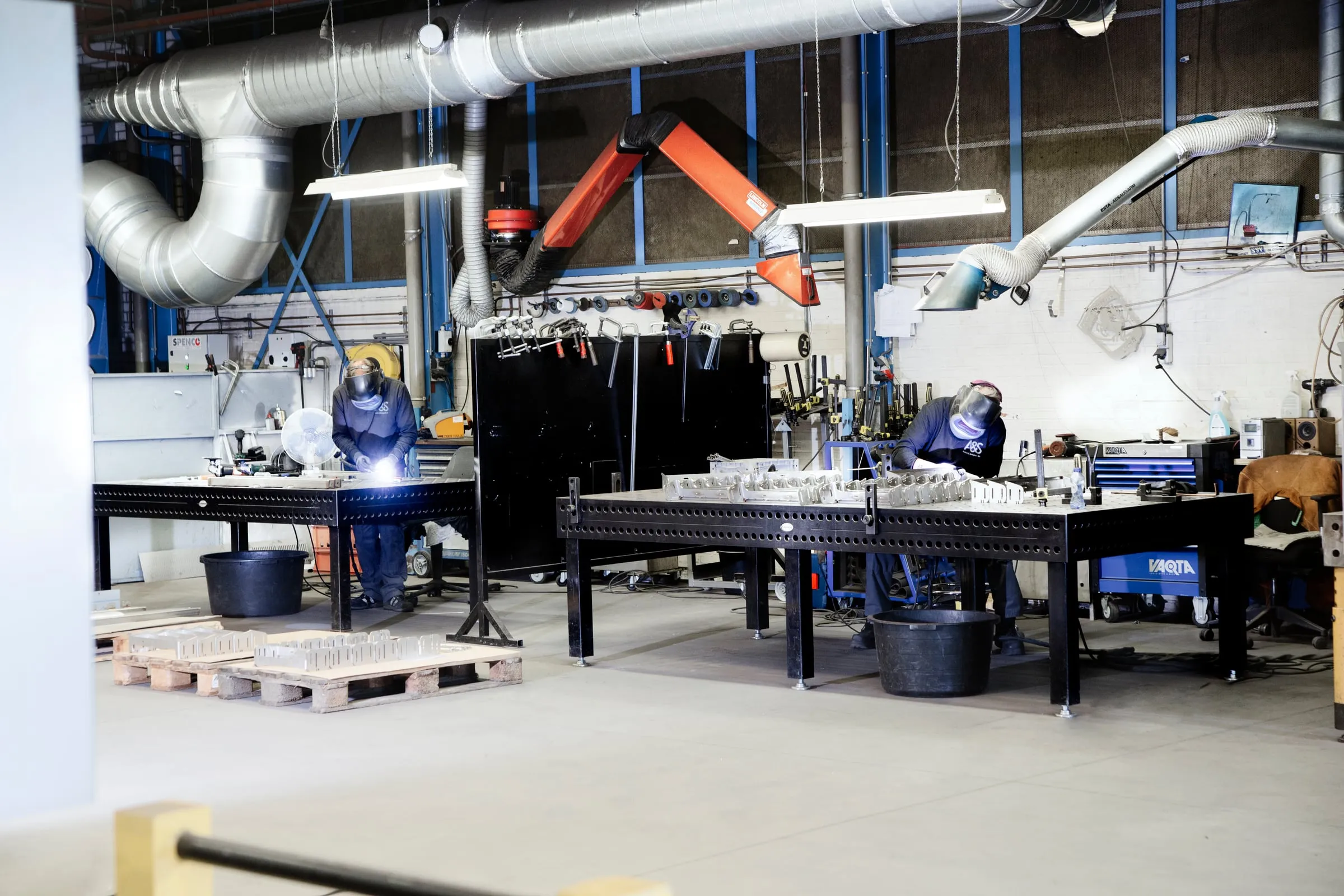
What sets stainless steel construction work apart from steel is not the welding itself, but what happens around it. Stainless steel has to be kept separate from carbon steel: dedicated tools, dedicated brushes, a dedicated work area. Residual steel dust rusts and draws rust spots onto an otherwise perfect surface — a mistake that only becomes visible weeks later, when the structure has long since been delivered.
After welding there is heat tint around the seam. That is not merely cosmetic: at that spot the chromium oxide layer has been damaged and the material is susceptible to corrosion. We pickle or blast that zone and then passivate, so that the oxide layer restores itself. For aluminium and stainless steel we have our own blasting cabin of 8 × 4 × 3 metres with glass beads of 100–200 μm.
For the profiles we use the Trumpf TruLaser Tube 3000. Cut-outs, mitres and pass-throughs come straight off the tube laser, so that parts fit without manual work and the seams stay even. That saves welding time and — more importantly with stainless steel — finishing, because every extra grinding operation is another spot that has to be treated again.
Hygienic environments impose additional requirements on the execution: fully welded and smoothly ground seams instead of tack welds, no cavities in which moisture can stand, and rounded transitions where possible. Tell us with your request whether the structure has to be cleanable and with which agents; that determines both the material choice and the seam execution.
Our structures go up to 10 tonnes unit weight and 8 metres in height. For welding we work under ISO 3834-2 and for load-bearing structures under EN 1090-1; our quality system is certified to ISO 9001.
Materials: Stainless steel 304 · Stainless steel 316
From drawing
to delivery
- 01
Tube laser cutting
Ready-to-fit tube and profile.
- 02
Welding
TIG or laser welding.
- 03
Finishing
Pickling and passivation.
- 04
Inspection
Dimensional and weld seam inspection.
Applications
Machine building · Food industry · Equipment manufacturing · Offshore & maritime
Frequently asked questions
Stainless steel 304 or 316 — which should I choose for my structure?
Stainless steel 316 contains molybdenum and is more resistant to pitting corrosion in environments with chlorides, such as seawater, brine or aggressive cleaning agents. Stainless steel 304 is adequate in drier and less aggressive conditions and is more economical. Tell us where the structure will be used and we will advise accordingly.
Why is passivation necessary after welding?
Welding damages the chromium oxide layer around the seam; at that spot the material becomes susceptible to corrosion. We remove heat tint by pickling or blasting and then passivate, so that the protective layer restores itself. Without that step a stainless steel structure will rust precisely at the weld.
Can you supply stainless steel structures for the food industry?
Yes. In hygienic environments we execute seams fully welded and smoothly ground instead of tack welded, avoid cavities in which moisture can stand and use rounded transitions where possible. Tell us which cleaning agents are used; that partly determines the material choice.
How heavy may a stainless steel structure be?
Up to 10 tonnes unit weight and 8 metres in height. Five overhead cranes of 5 tonnes are installed in the hall; by lifting in tandem we move assemblies of up to 10 tonnes.
Do you process stainless steel and carbon steel in the same workshop?
We keep stainless steel separate from carbon steel, with dedicated tools and dedicated brushes. Residual steel dust rusts and causes rust spots on an otherwise perfect stainless steel surface; that only becomes visible weeks later and is hard to repair by then.
Discuss your drawing,
part or assembly.
Response within one working day · 074-2912235 · info@assinkschipholt.nl