
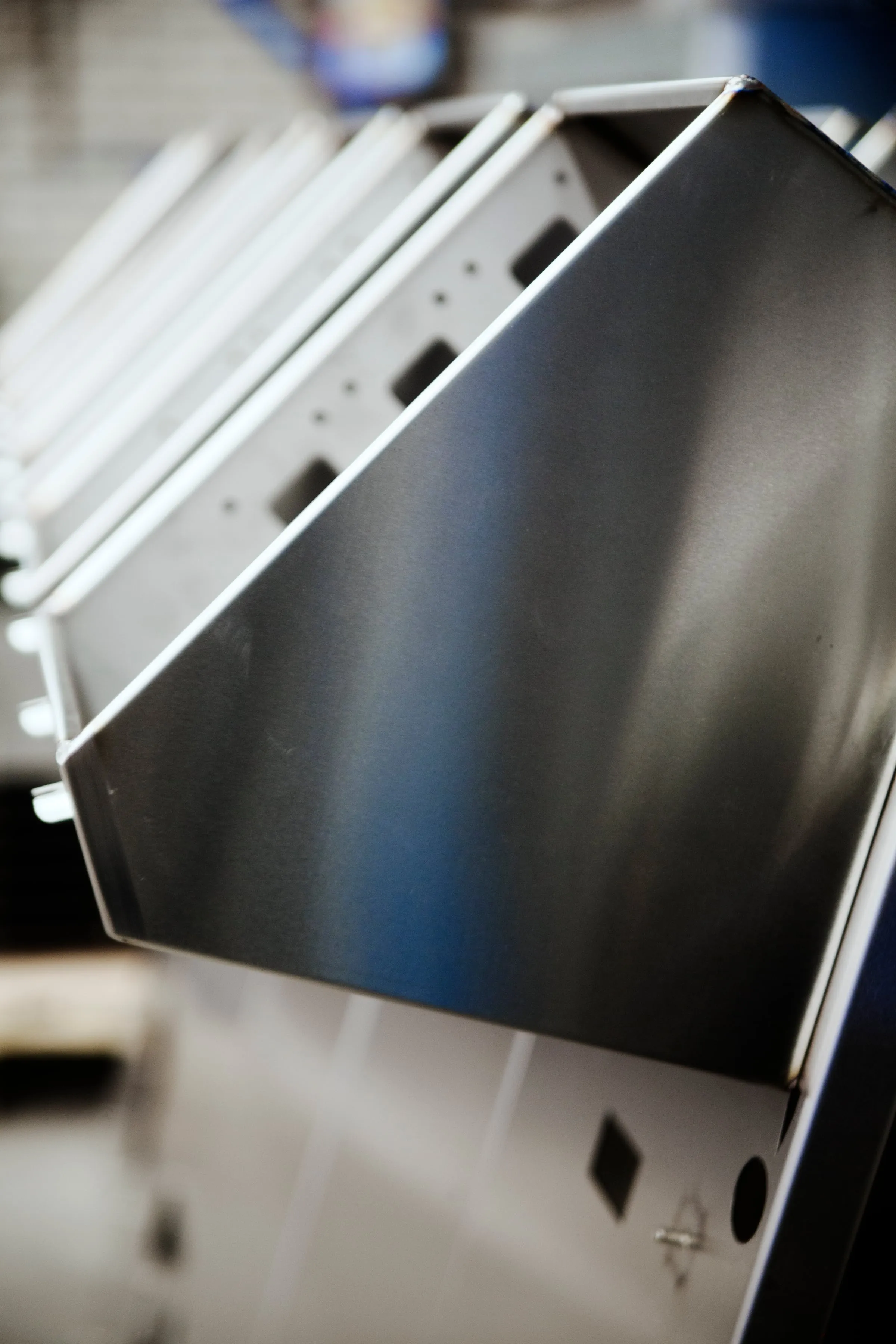
Stainless steel sheet metal
Ground stainless steel sheet metal for visible surfaces: corrosion-resistant, presentable and dimensionally stable. Our stainless steel sheet processing covers laser cutting, press braking, deburring and passivation.
About this operation
Stainless steel is ideally suited to applications that must be corrosion-resistant as well as presentable. We mainly work with stainless steel 304 and 316.
For visible surfaces we supply ground finishes with a consistent grain. Cutting is done with the laser; edges are deburred and, where required, passivated.
Stainless steel sheet processing calls for care: incorrect welding parameters or carbon steel residue on the surface lead to rust formation. We passivate after welding, so the corrosion-resistant surface stays intact.
From one-off visible work to series stainless steel sheet metal for the food industry or machine building: every batch is finished with the same grain and the same tolerances.
On the Trumpf TruLaser 3040 we cut stainless steel from 0.5 to 20 mm. Which thickness makes sense depends on the load and on the subsequent operations: thinner material is lighter and cheaper, but across large surfaces it needs stiffeners or bent flanges to stay flat. For visible surfaces we also consider the grain direction, so that it runs consistently across the separate parts of an assembly.
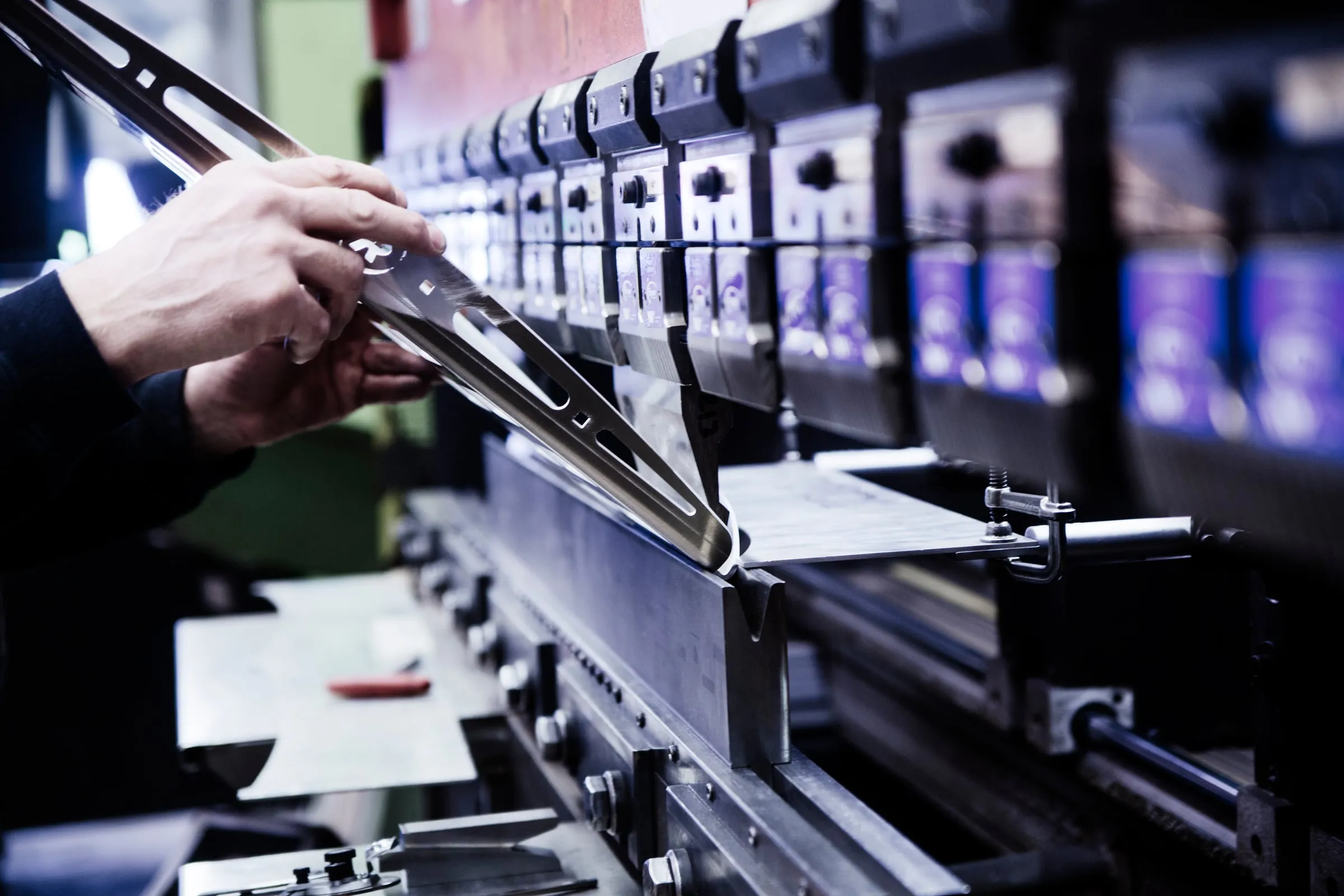
Press braking stainless steel calls for more care than steel: the material springs back more and the surface is sensitive to scratches. We bend on a servo-electric press brake with a working length of up to 3100 mm and use protective film and adapted tooling for visible work. Read more on our page about press braking.
To assess a request properly we need: a drawing or 3D model, the required grade, the sheet thickness, whether it concerns visible surfaces and which finishing that requires, and the quantity involved. If you are weighing 304 against 316, we set out the difference in our article on stainless steel 304 or 316 (in Dutch).
Not every joint has to be welded. For visible work we often choose laser welding, because the narrow seam introduces little heat and therefore requires little finishing. Where a demountable or continuously loaded connection is needed, we work with self-clinching and rivet nuts. Which route is best depends on the load, the visible side and the number of assembly cycles.
Materials: Stainless steel 304 · Stainless steel 316 · Ground / brushed
From drawing
to delivery
- 01
Laser cutting
2D laser cutting with minimal tolerances.
- 02
Press braking
Precise bend angles on the press brake.
- 03
Deburring
Burr-free, safe edges.
- 04
Welding & finishing
Laser/TIG welding and passivation for visible surfaces.
Applications
Food industry · Machine building · Enclosures · Visible surfaces
Frequently asked questions
What sheet thickness in stainless steel can you laser cut?
On the Trumpf TruLaser 3040 we cut stainless steel from 0.5 to 20 mm. Which thickness makes sense in your case depends on the load and on the subsequent operations. If your request falls outside that range, put it to us and we will see what is possible within the group.
What is the difference between stainless steel 304 and 316?
Stainless steel 316 contains molybdenum and is therefore more resistant to pitting corrosion, particularly in environments with chlorides or a lot of moisture. 304 performs well in drier, less aggressive applications. We process both grades; our knowledge base article on 304 and 316 sets out the trade-off in more detail.
Do you supply ground stainless steel for visible surfaces?
Yes. For visible work we supply ground finishes with a consistent grain and make sure the grain direction runs across the separate parts of an assembly. Protective film stays in place through to the final operation, because stainless steel is sensitive to scratching.
Do you passivate stainless steel after welding?
Yes. Welding affects the protective oxide layer around the seam, which makes that area more susceptible to corrosion. We remove heat tint and passivate after welding, so that the corrosion resistance of the surface is retained.
Discuss your drawing,
part or assembly.
Response within one working day · 074-2912235 · info@assinkschipholt.nl