
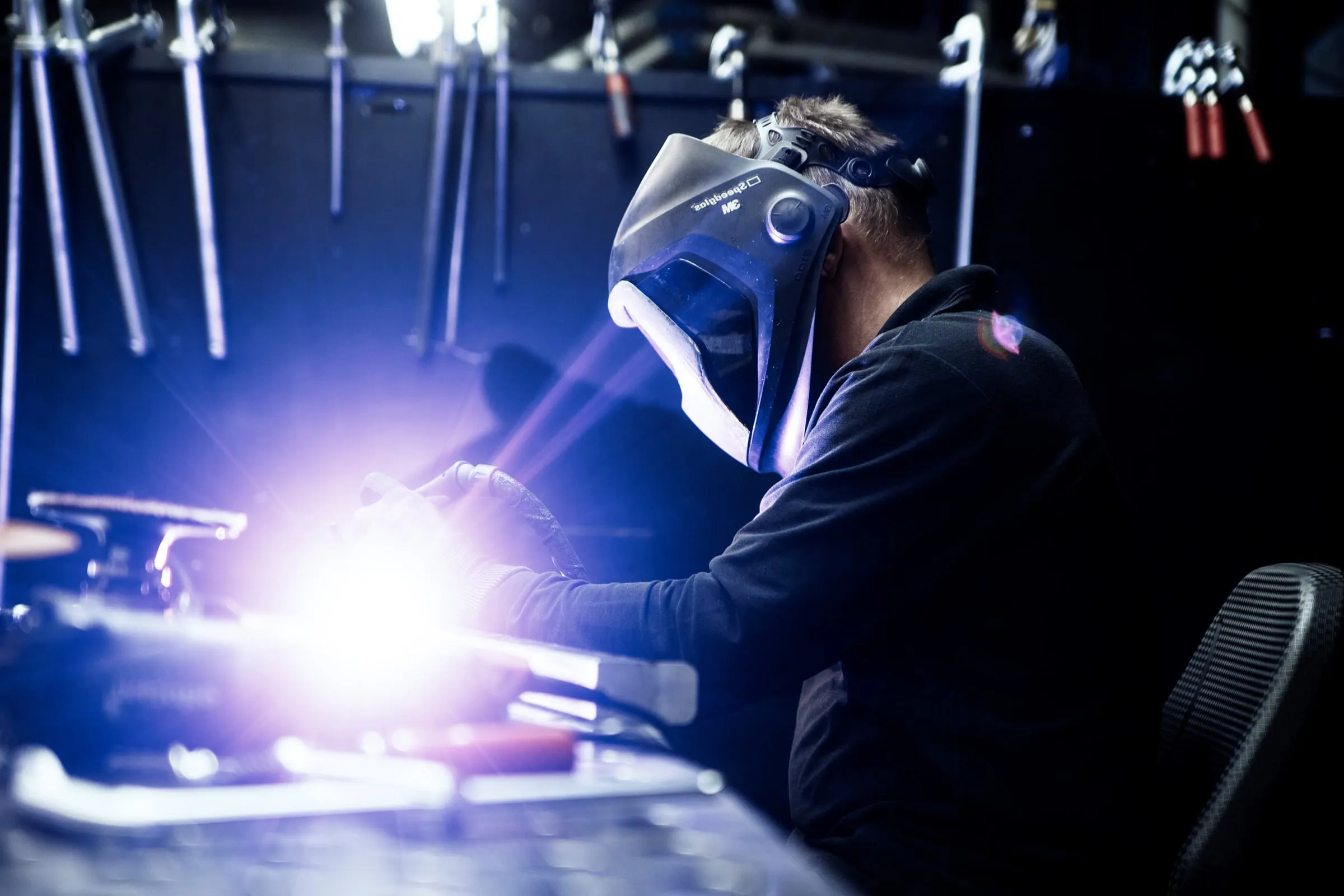
Perfection in laser welding
Precision welding for OEMs and industrial customers that need extreme accuracy and short lead times. Specialised in laser welding of stainless steel and aluminium.
About this operation
Laser welding with minimal heat input results in clean, low-distortion welded joints that are immediately suitable for assembly. That is a major advantage particularly on visible surfaces and thin material.
Finishing, bending work and integration into complete assemblies take place in house. With our own stock, just-in-time delivery, short lines of communication and a single point of contact.
In laser welding the heat is introduced into a very narrow zone. The heat-affected zone therefore stays small and the workpiece hardly distorts — exactly what you want with thin material and with parts that must remain dimensionally stable after welding. With conventional TIG welding the heat input is higher and you have to allow more often for straightening and rework.
The difference is most visible on the outside. A laser seam is narrow and even and needs little to no grinding on visible surfaces. That saves more than time: every grinding operation removes material and, on ground stainless steel, disturbs the grain direction, which then has to be rebuilt across the whole assembly.
Laser welding does place higher demands on preparation. Because the beam is small, there is little gap bridging: the parts have to fit tightly and be firmly fixtured. We therefore cut the parts on the laser and use fixturing where required. For larger gaps or for a seam that has to fill volume, TIG or MIG welding is the better choice; we make that assessment per product.
In stainless steel the same rule applies after every welding operation: the heat attacks the protective oxide layer around the seam. We remove heat tint and then passivate, so that corrosion resistance returns. With laser welding that zone is narrower than with TIG, but it is there — skipping it is not an option, certainly not in a wet or hygienic environment.
We laser weld in stainless steel 304 and 316, aluminium and brass, and build the welded parts up into complete assemblies. Want to know whether your product lends itself to laser welding? Send the drawing with the sheet thickness, the joint geometry and the requirement for the visible side; we will indicate which welding method suits best and what that means for finishing.
Materials: Stainless steel 304 / 316 · Aluminium · Brass
From drawing
to delivery
- 01
Preparation
Fitting up and fixing in place.
- 02
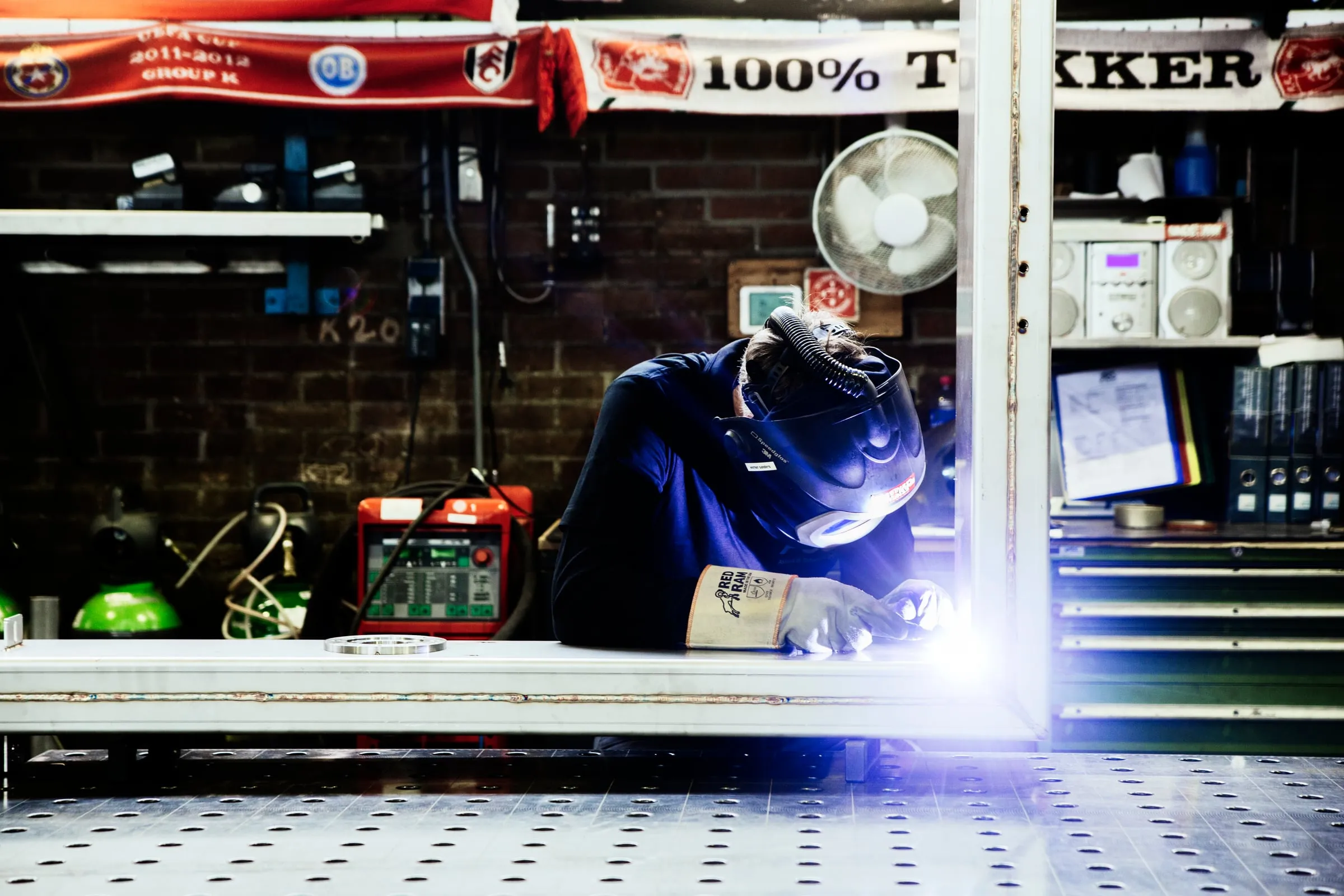
Laser welding
Concentrated, low-distortion seam.
- 03
Finishing
Grinding and passivating where required.
- 04
Integration
Build-up into a complete assembly.
Applications
Food industry · Machine building · Visible surfaces
Frequently asked questions
What is the advantage of laser welding over TIG welding?
The heat input is far lower, so the heat-affected zone stays small and the workpiece hardly distorts. The seam is narrow and even and needs little finishing on visible surfaces. TIG remains the better choice for larger gaps or when the seam has to fill volume.
Which materials can you laser weld?
Stainless steel 304 and 316, aluminium and brass. Which material and joint geometry are feasible depends on the sheet thickness and on how accurately the parts fit together; we assess that on the drawing.
Does a laser-welded seam still need finishing?
Usually very little: the seam is narrow and even, so grinding is often unnecessary. With stainless steel one step always applies — removing heat tint and passivating — because the heat attacks the protective oxide layer around the seam.
How accurately do the parts have to fit for laser welding?
More accurately than for TIG. The laser beam is small and bridges little gap, so the parts have to fit tightly and be fixtured. We therefore cut them on the laser and use fixturing where required. If a tight fit is not achievable, we advise TIG or MIG.
Do you also offer robot welding?
Not in house. Robot welding is done within our group at Baas Metaal. We handle the coordination and the assembly, so that it remains a single order for you. For smaller batches and visible work, laser welding with us is often the more logical route.
Discuss your drawing,
part or assembly.
Response within one working day · 074-2912235 · info@assinkschipholt.nl