
Deburring
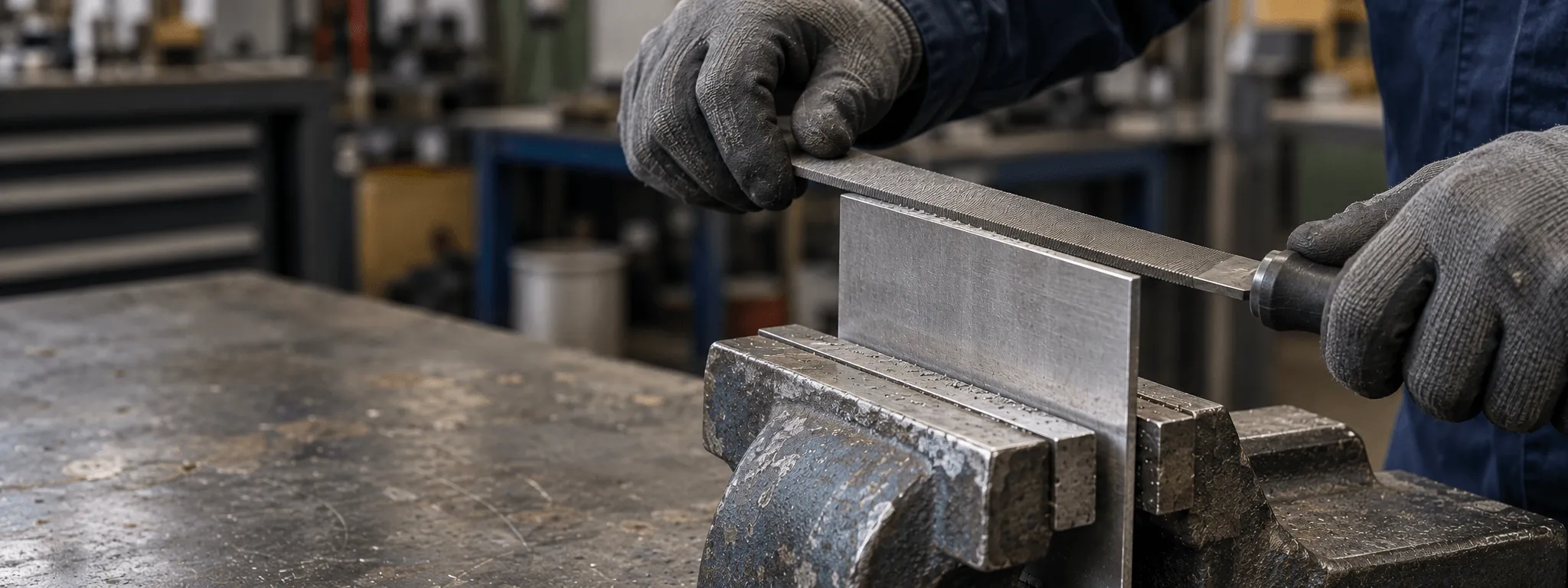
Laser cutting leaves a burr on the cut edge. We remove it by machine, so that your sheet metal parts are safe to handle and go through bending, welding and finishing without problems.
About this operation
- Steel
- Stainless steel
- Aluminium
- Brass
- Parts for bending and welding
- Visible surfaces
- Assembly-ready parts
- Parts for powder coating
During laser cutting a small amount of molten material solidifies on the underside of the cut edge. That burr is sharp enough to cut yourself on and gets in the way of subsequent operations: a part with a burr does not sit flat against the press brake backgauge, a weld seam fits up less well and a powder coating adheres less well to a sharp edge.
We deburr in house on a Timesavers 42 Series RB, a wide-belt machine for flat workpieces. After cutting, the parts travel on the conveyor through the machine, which removes the burr, lightly rounds the edges and evens out the surface. Because this is done by machine, the result is consistent across the whole series — even with hundreds of parts.
Read more
Deburring is done before bending, while the part is still flat. That is also why it comes directly after laser cutting in our routing: a bent part no longer passes flat through the machine.
The emphasis differs per material. With steel it is not only about appearance but above all about safety further down the chain. With stainless steel, deburring is followed where necessary by glass bead blasting and, after welding, passivation. With aluminium, deburring and a visual check are sufficient if the edge is out of sight. For visible brass parts the protective film stays on as long as possible.
From drawing to delivery
Laser cutting
The part is cut; a burr forms on the underside of the edge.
Deburring
By machine on the Timesavers 42 Series RB, while the part is still flat.
Edge rounding and brushing
Lightly rounding sharp edges and evening out the surface.
Next in the routing
Bending, welding or finishing with a burr-free part.
Specifications
Indicative values — to be confirmed per project- Machine
- Timesavers 42 Series RB (GrindingMaster)
- Type
- wide-belt brushing and deburring machine
- Workpieces
- flat sheet metal parts, before bending
- Materials
- steel, stainless steel, aluminium, brass
What to send us
Request a quote- PDF drawing and a 3D STEP file
- Material and sheet thickness
- Number of parts
- Whether the parts need deburring, and whether it is visible work
Frequently asked questions
Why do laser-cut parts need deburring?
A burr is sharp and makes a part unsafe to handle. It also gets in the way of subsequent operations: the part does not sit flat against the press brake backgauge, weld seams fit up less well and a coating adheres less well to a sharp edge.
Can you also deburr bent parts?
Our Timesavers is a machine for flat workpieces. That is why we deburr directly after laser cutting, before bending. If you supply parts that are already bent and still need deburring, please contact us and we will look at what is possible case by case.
Is deburring standard in your sheet metal work?
For sheet metal that we go on to bend, weld or finish, it is part of the routing. If you only order cut parts, please state in your request whether you want them deburred.
What is the difference between deburring and blasting?
Deburring removes the burr and rounds the edges. Glass bead blasting is a surface treatment that removes, among other things, heat tint and contamination after welding and gives an even matt surface. With stainless steel they often follow one another.
Discuss your drawing,
part or assembly.
Response within one working day · 074-2912235 · info@assinkschipholt.nl