
Steel sheet metal work
The workhorse among sheet materials — stiff, readily weldable and economical. From individual parts to welded assemblies, with or without finishing.
About this operation
Steel is usually the starting point in sheet metal work. It is stiffer than aluminium at the same thickness, readily weldable and considerably cheaper than stainless steel. Where there is no corrosion or visible-surface requirement, steel is almost always the sensible choice.
On the Trumpf TruLaser 3040 we cut steel from 0.5 to 25 mm and galvanised steel from 0.5 to 10 mm, from sheet up to 4000 × 2000 mm. Galvanised steel calls for a different approach: the zinc layer vaporises during cutting and welding, so we adjust the cutting parameters accordingly and agree in advance whether the weld zones need to be restored afterwards.
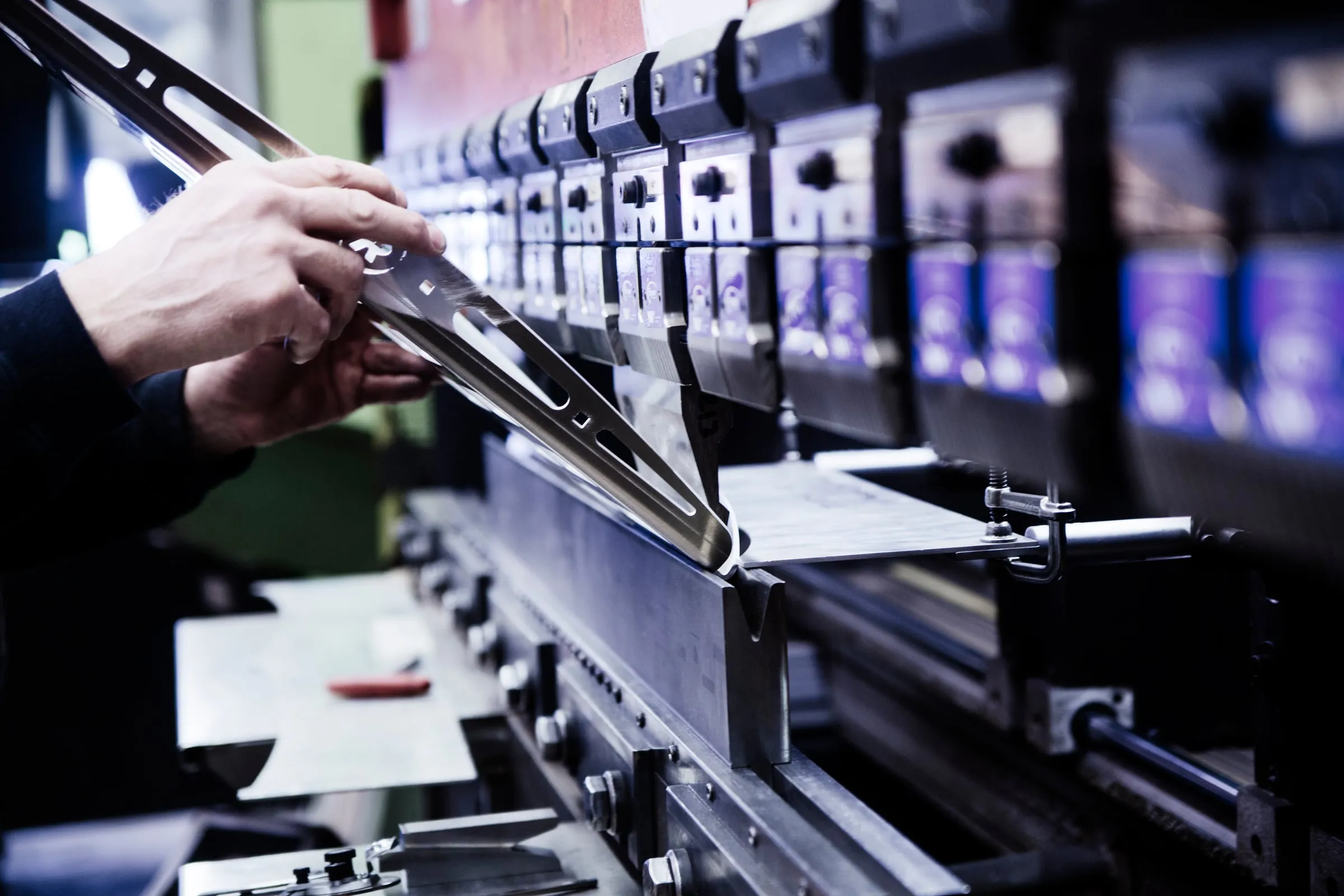
Press braking takes place on our servo-electric Safan Darley E-Brake 150-3100 T3, with 150 tonnes of press force and a working length up to 3100 mm. We hold tolerances to ISO 2768; if you need tighter dimensions, put them to our production engineering.
For welding steel, MAG is the usual process: welding with active gas, faster than TIG and suited to thicker material and larger series. We use TIG where the seam has to look clean or the material is thin. Our page on welding explains how we choose.
Finishing is a choice with steel, not a given. We deburr mechanically on the Timesavers 42 Series RB — with steel that is a matter of workplace safety further down the line, not only of appearance. We do not apply protective coatings ourselves: powder coating, galvanising and wet painting go to regular partners, so you keep a single point of contact.
If it concerns a welded steel structure rather than individual sheet parts, a different route applies. We weld under ISO 3834-2 and are certified to EN 1090-1, with a maximum piece weight of 10 tonnes. See our page on welded constructions.
Materials: Steel (S235, S355) · Galvanised steel
From drawing
to delivery
- 01
Laser cutting
Steel 0.5–25 mm, sheet up to 4000 × 2000 mm.
- 02
Press braking
Up to 3100 mm, tolerances to ISO 2768.
- 03
Welding
MAG for steel, TIG for thin and visible work.
- 04
Finishing
We deburr in house; coating goes to partners.
Applications
Machine building · Structural parts · Frames & supports · Industrial applications
Frequently asked questions
What steel thickness can you laser cut?
Steel from 0.5 to 25 mm and galvanised steel from 0.5 to 10 mm, on the Trumpf TruLaser 3040, a 4 kW fibre laser. Sheet may measure up to 4000 × 2000 mm.
What is the difference between MAG and MIG welding on steel?
Both are processes with filler wire; the difference is the shielding gas. MAG uses active gas and is the usual process for steel; MIG uses inert gas and is intended for stainless steel and aluminium. So for steel we weld with MAG, or with TIG where the seam has to be clean.
Do you also arrange powder coating or galvanising?
We arrange it but do not carry it out ourselves. Powder coating, galvanising and wet painting go to regular partners. Deburring we do in house, mechanically on the Timesavers 42 Series RB.
When do I choose steel and when stainless steel or aluminium?
Steel is stiffer than aluminium at the same thickness and considerably cheaper than stainless steel, but it corrodes without protection. If the part goes into moisture, outdoors or somewhere that is cleaned, stainless steel is the logical choice. If weight matters, aluminium. If neither applies, steel.
Can you process galvanised steel?
Yes, from 0.5 to 10 mm. One point to note: the zinc layer vaporises during cutting and welding. We adjust the cutting parameters accordingly and agree in advance whether the weld zones need restoring afterwards.
Discuss your drawing,
part or assembly.
Response within one working day · 074-2912235 · info@assinkschipholt.nl